Authors:
Paul O’Grady, VP Scientific Communications and Health Economics, ADMA Biologics
Teri Michelini, Global Head, Scientific Publication and Data Sharing, Sanofi
Renu Juneja, President, ADPAL LLC: a boutique advisory company
Acknowledgment: Authors would like to thank ZS associates for providing resources and project support especially thank Patrice Pearce-Grullón, Senior Research Scientist for her project management, meetings & workshops summarization, and creating & updating different versions based on comments by the authors & the steering committee members.
Disclaimers: The opinions expressed herein are those of authors and contributors and do not represent the perspectives of their respective companies.
Artificial Intelligence (AI) was used in developing this whitepaper. Please see detailed prompts in the Appendix.
Key Takeaways:
- Medical Communications is evolving from a support function into a strategic enterprise partner for integrated scientific exchange and medical education.
- The white paper’s core vision is an Integrated Medical Communication Strategy (iMCS), supported by future-ready structures, clear ownership, and new capability development.
- Digital and AI adoption, new publishing/content models, and stronger impact measurement are central to how the function will operate going forward.
- Success depends on balancing global consistency with local relevance while managing the tensions that come with implementing this broader operating model.
Executive Summary
Medical Communications is entering a decisive era of change. Once defined primarily by publications planning and congress support, the function is assuming a broader role as the enterprise architect of integrated scientific exchange and medical education. This transformation does not replace foundational activities such as publication development; rather, it expands their impact by situating them at the nexus of a unified, integrated, end-to-end cross-functional communication strategy that can be scaled at the enterprise level.
The volume, speed, and complexity of scientific evidence have increased dramatically, while the number of channels through which stakeholders access that data has multiplied. In this environment, disconnected communication outputs—however rigorous individually—can fragment understanding, dilute impact, and erode trust. Ensuring that evidence is interpreted, communicated, and reinforced coherently, consistently, clearly, and concisely across touchpoints has become essential to supporting appropriate adoption in clinical practice.
These recommendations and best practices were conceived through a series of workshops convened by the authors who were members of the Medical Communications Focus-Area Working Group (FAWG) of the Medical Affairs Professional Society (MAPS) and partnership with ZS Associates. Discussions with over 25 leading global medical communications professionals helped in developing this White Paper on a shared vision for 2035.
This transformation is defined by eight interconnected themes: the shift toward Medical Communications as a strategic partner; the establishment of an Integrated Medical Communication Strategy (iMCS) including future-ready organizational structure; development of future-critical capabilities; clear ownership and accountability; responsible adoption of digital and AI technologies; evolution of publishing and content models; meaningful impact measurement; and the balance of global consistency with local relevance.
This white paper also addresses how to resolve different tensions while implementing iMC, pillars of success as well as recommendations and next steps.
1. Introduction: Why Medical Communications must change
Medical Communications is already operating in a fundamentally different environment, and the urgency to adapt has never been greater. Scientific evidence generation is expanding at unprecedented speed and complexity, increasing pressure to deliver timely, relevant, and trustworthy information to healthcare professionals (HCPs), payers, and policy leaders. At the same time, AI-enabled content development is transforming expectations for efficiency and prioritization while HCPs engage with content across a broader mix of digital and social platforms with increasingly diverse learning preferences. Together, these shifts raise the bar to deliver the right information to the right audience at the right time in the right channel & format.
Without a unified and integrated strategic approach, it weakens impact, erodes trust and creates duplicate work and resources.
Medical Communications must therefore lean into being a strategic lead to develop and execute the integrated medical communications strategy (iMCS). In collaboration with cross-functional teams, the function must help shape the overall medical affairs strategy. This necessary change reflects the recognition that the communication strategy cannot be developed in isolation from broader organizational objectives. However, leadership buy-in is critical for Medical Communications to function effectively in this role and should have a seat at the table to discuss both medical affairs and evidence generation strategies.
2. The Strategic Shift: Medical Communications as a Strategic Partner
For decades, publications have been the cornerstone of Medical Communications. Peer-reviewed manuscripts, abstracts, and related materials remain foundational and essential to scientific exchange. However, publications alone are no longer sufficient to meet the needs of today’s external stakeholders or the strategic expectations placed on Medical Affairs functions.
Scientific evidence does not exist in isolation. Stakeholders encounter information across multiple venues and platforms, including publications, congress interactions, medical education programs, medical information inquiries, field discussions, and digital platforms. When these touchpoints are not intentionally and strategically connected, even high-quality evidence risks being misunderstood, underutilized, or overlooked.
“If you’re not a strategic partner, then you’re just doing operations.”
— Workshop 1 Participant
Orchestration represents a deliberate shift away from medical communication being seen as a collection of discrete outputs and taking a lead in managing it as a unified, enterprise-level ecosystem. In this model, Medical Communications is accountable not only for the accuracy of the evidence, but for how it is framed, presented and leveraged across channels to support understanding and informed decision-making.
Importantly, orchestration is not a future aspiration. It is needed now. Elements of it already exist in many organizations, including modular content approaches, integrated evidence generation and communication, scientific narratives, and coordinated congress strategies. What is often missing is clear ownership and an explicit mandate to connect these elements into a unified strategy.
This shift strengthens scientific rigor but changes the scope of responsibility. Rather than asking if an individual data set is ready for publication, the focus expands to whether the body of evidence tells a coherent, credible scientific story over time across all channels.
3. The Integrated Medical Communication Strategy (iMCS)
The Integrated Medical Communication Strategy serves as the formal framework through which orchestration is strategically designed and subsequently operationalized. It is not a single document or deliverable, but an operating and organizational structure model that ensures consistent and clear communication across functions, channels, and stages of the product lifecycle.
At its core, the iMCS defines shared decisions: which scientific narratives matter most; which evidence supports them; which audiences require what information; and how that information should be sequenced to maximize relevance and understanding. It provides the strategic logic that connects scientific data to real-world engagement.
Crucially, the iMCS does not replace functional ownership. The iMCS ensures that execution across functions is aligned, complementary, leveraged, and grounded in a consistent scientific narrative.
Because of this integrative role, accountability for the iMCS must be clearly defined. Medical Communications is uniquely positioned to own and lead the iMCS, given its intersection of scientific rigor, narrative development, and cross-channel deployment. Ownership is not defined by unilateral control; instead, it is operationalized through structured collaboration, explicit decision rights, and clear governance mechanisms.
Figure 1 illustrates a proposed future-state organizational model designed to deliver the integrated strategy across therapeutic areas (TAs).
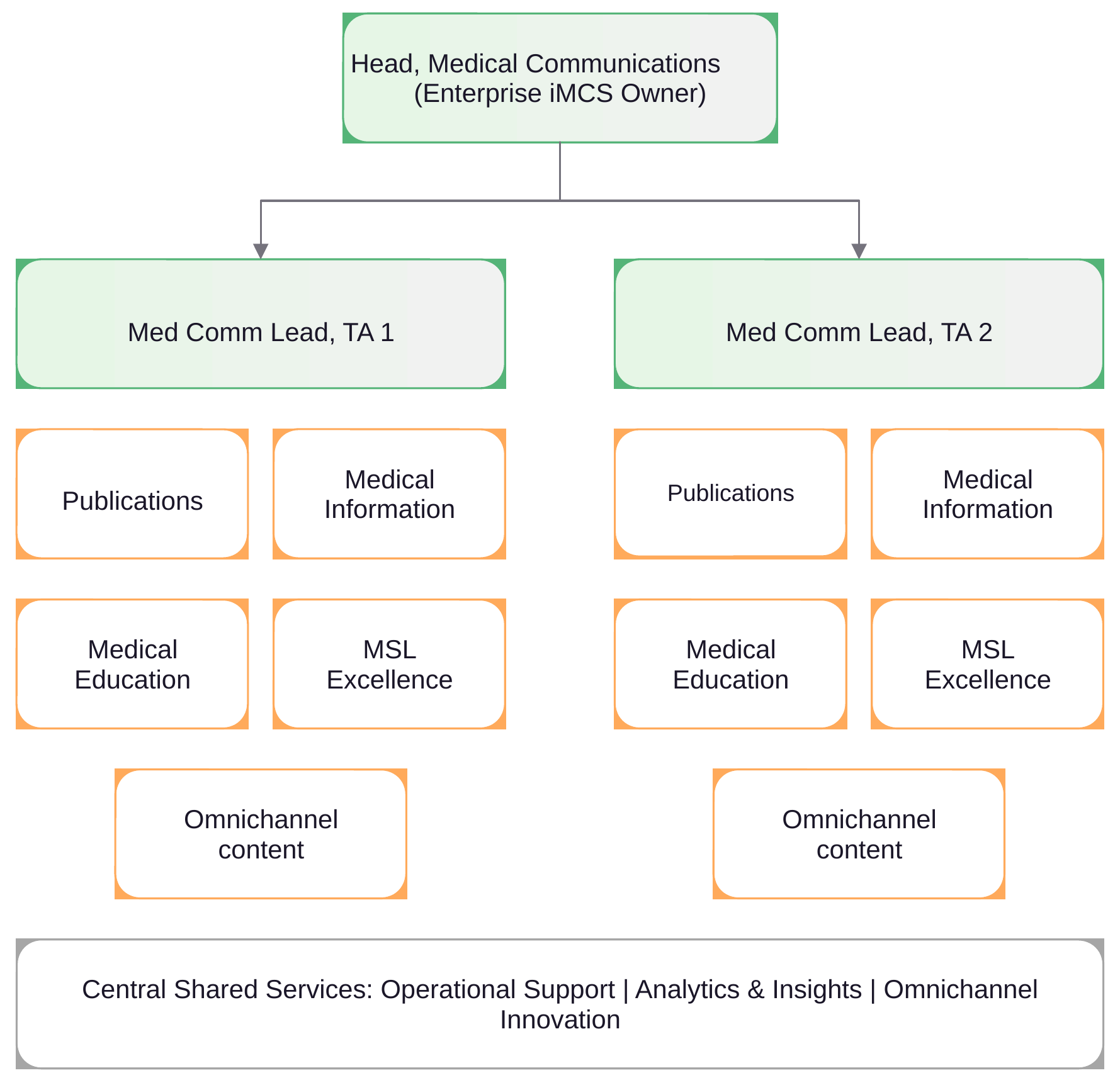
Figure 1. Future-state Medical Communications operating model for 2035. The model combines enterprise-level direction from the head of Medical Communications (Med Comm) with therapeutic area (TA) accountability for pull-through of all medical content and related work; central shared services support consistent ways of working while enabling scalable execution. Headcount needs would vary based on volume and is not necessarily a 1:1 ratio across sections.
Dedicated Medical Communications leads for each TA are responsible and accountable for setting these communication objectives across Scientific Narratives, Publications, Medical Information, Medical Education, Medical Science Liaison (MSL) Excellence and omnichannel (digital/social etc.) content. Central Shared Services support scale and consistency through operational expertise, analytics and insights, and omnichannel innovation.
This structure provides clear ownership, cross‑functional alignment, and a foundation for consistent, credible scientific communication. Other functions contribute insights, expertise, and executional excellence within a shared strategic framework. This clarity of ownership is what enables integration at scale.
Success of this model is not determined by organization size. A lean, consolidated version of this model in a smaller organization that operates with clear accountability, strategic alignment, and continuous attention to quality and rigor can outperform a complex model at a larger organization that lacks clear decision or ownership clarity or strategic coherence.
Organizations vary in maturity, size, regulatory environment, etc., thus this model may not be feasible for all companies, however it is a scalable framework that companies at different stages can adapt based on their needs. That said, when designing an operating model, you need a structure that can:
- Anchor accountability
- Enable scale and consistency across TAs (if applicable)
- Clarify roles, handoffs, and ways of working
- Support current and emerging capabilities
- Promote alignment, consistency, and leveraging of content across all parts of iMC
Ultimately, the framework and capability build needs to support the now and the future and not be solely focused on immediate need.
4. Core competencies: Expanded skills
As Medical Communications transforms into the driver of integrated medical communications , the capabilities required to succeed will expand to include strategic thinking, storytelling, creativity, and digital and AI literacy. This expansion must not be misinterpreted as a shift away from science. Scientific acumen remains the non-negotiable core of the function.
The ability to critically evaluate data, understand clinical context, assess evidentiary strength, and anticipate scientific scrutiny underpins every credible communication decision. No degree of strategic, digital, or technological sophistication can compensate for insufficient scientific expertise.
However, the future Medical Communications professionals must own scientific acumen and expertise for their therapeutic area alongside a strategic mindset: translating evidence into clear choices about narrative prioritization, channel selection, and sequencing across the communication lifecycle. This mindset is critical to the role today; what changes under the iMCS is the need to build capability breadth, developing these capabilities across the role rather than limiting them to specific functional positions. Storytelling and information design are other valuable competencies, enabling the synthesis of complex evidence into coherent, accessible narratives without compromising accuracy.
A significant increase in number of publications and digital engagement patterns also require analytical proficiency, including the ability to mine data for insights, interpret behavioral analytics, and use findings to tailor communication strategies. Digital and AI-enabled capabilities—from channel orchestration and prioritizing information based on stakeholder preferences and needs, to responsible use of AI tools for drafting, analysis, and scale—serve as enablers that enhance operational efficiency but never as substitutes for scientific judgement
“If we are looking to 2035, digital mindset, social media mindset, Gen AI mindset—all of those are going to be very, very important.”
— Workshop 2 Participant
Fill out the Form to Read More
ZS White Paper - A Vision for Medical Communications 2035
INTERESTED IN HOSTING A ROUNDTABLE?
This article summarizes a Roundtable hosted by a MAPS Partner Circle member that brought together leading experts from across the industry. If you are a solution provider interested in hosting your own Roundtable, please check out our Media Planner or contact Luke with MAPS: [email protected].

